A3Access Advisors works at a specific and consequential seam in pharma: the gap between a drug that works and a drug that patients can actually get. Market access - payer coverage, reimbursement, pricing, contracting, site of care - decides whether a novel therapy reaches people or stalls quietly after approval.
Their argument is that this cannot be bolted on at launch. It has to be built into development, years earlier, while there is still time to change the evidence plan. Their framework is getting the right treatment to the right patient at the right time, in the optimal site of care, and at the right price.
The difficulty for a firm like this is that the category all sounds identical. Every consultancy in the space claims strategic partnership and deep expertise, and the audience - commercial leadership at biotechs heading into a launch - has read every version of that sentence.
So the engagement started with discovery rather than design. The question I wanted answered before anyone opened Figma was narrow: what does this firm do that a prospect could not get somewhere else?
The answer turned out to be about timing, not services. Most market access support arrives near launch, when the trial is done and the evidence is whatever it is. A3Access embeds the thinking into development, when access considerations can still shape trial design, comparator choice, endpoint selection and the evidence-generation plan. That is a materially different offer, and it was buried under generic category language.
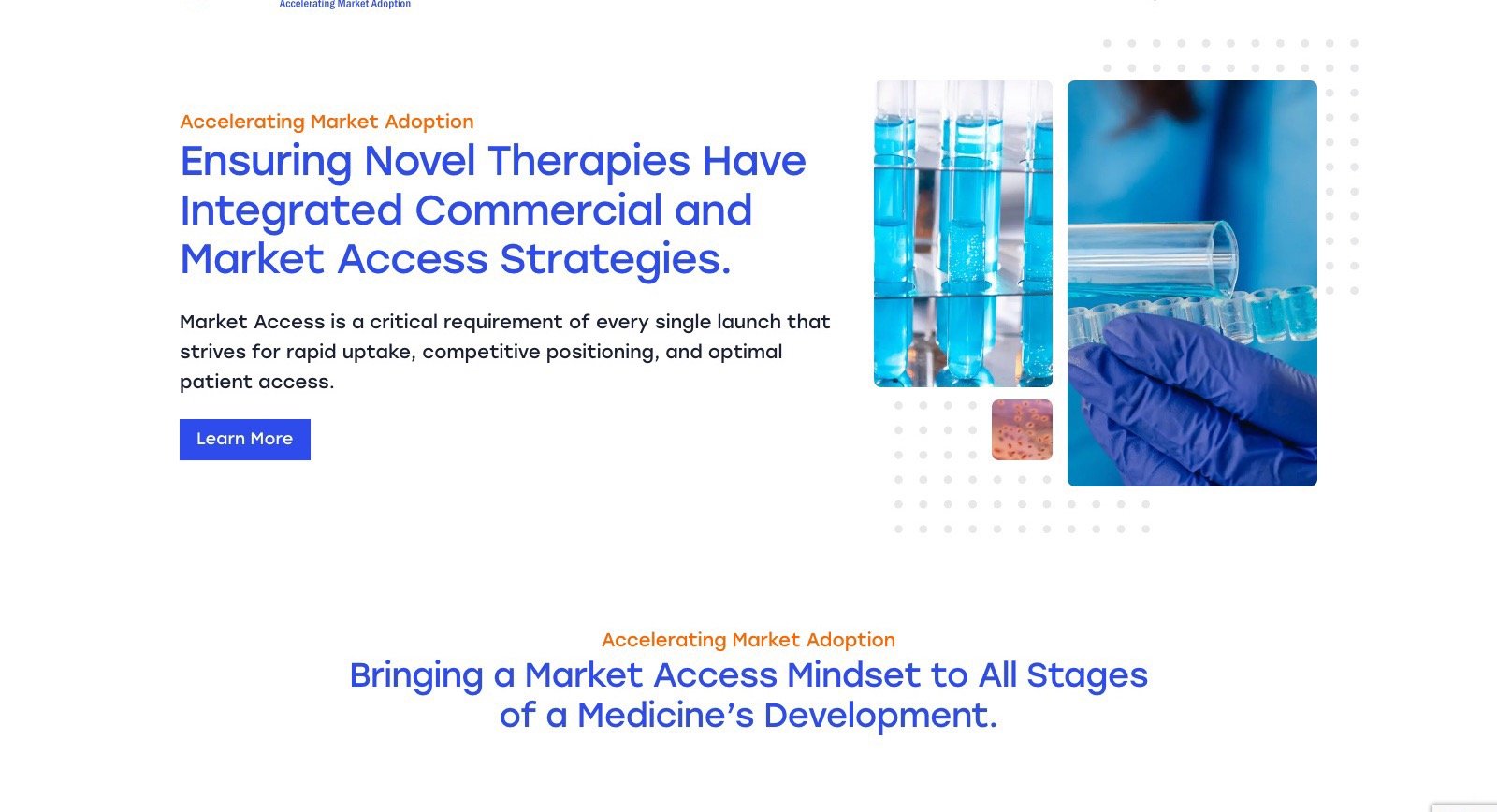
That became the spine of the positioning - bringing a market access mindset to all stages of a medicine's development - and it gave every downstream decision a test to pass. Discovery also produced the four service pillars the site is built around: commercial analysis and insights, value proposition creation, strategy development, and capability enhancement.
Their differentiator was when they engage, not what they do. Everyone in the category can list the same services. Almost nobody can credibly say they were in the room three years before launch.
The content problem was structural. A3Access works across eight therapeutic areas - oncology, neuroscience, autoimmune, rare disease, ophthalmology, respiratory, hematology, and cell and gene therapies - and the access dynamics of a rare disease launch have almost nothing in common with an oncology launch. A single site has to speak credibly to all of them without collapsing into a list of capabilities.
The strategy was to organise the site around the stage of development a visitor is at, and to use therapeutic expertise as evidence rather than as navigation. A commercial lead two years from filing and one six months from launch have different questions; the site answers whichever one you arrive with, then demonstrates depth in your area as proof rather than as a menu.
Built as a custom WordPress theme - no page builder - on a modular block system, so the team can publish insights and case work without a developer in the loop. Same principle I apply to email component libraries, applied to a marketing site.

Separately from the brand work, A3Access was building an internal drug valuation model and wanted a view on where language models fit. I consulted on implementation strategy - not on the financial modelling, which is their expertise, but on which parts of the workflow an LLM should and should not touch.
Valuing a pre-commercial asset is mostly evidence assembly. Payer policies, HTA decisions, analog launch trajectories, competitive pipeline, epidemiology, pricing precedent, and increasingly the policy overhang from Medicare negotiation. Analysts spend the bulk of their hours gathering and normalising that material and comparatively few on the judgment that produces a number.
That asymmetry is the opportunity, and it points at a very specific recommendation.
Pull coverage criteria, prior-authorisation requirements, step edits and pricing out of long unstructured documents into a fixed schema - with the source passage cited beside every extracted field, so an analyst verifies in seconds instead of re-reading the policy.
Surface comparable launches and state why they're comparable - mechanism, population size, site of care, payer posture. A research accelerant a human then accepts or rejects, not a conclusion.
The moment a model produces the number, you have built something confidently wrong in ways nobody can audit. The math stays deterministic and every assumption stays attributable to a named person who can defend it.
Measure extraction accuracy against a held-out set of assets the team had already worked manually. Known-good answers, not impressions - because "it seems to do a good job" is not a basis for putting a model near a valuation.
The model's job is to get an analyst to a defensible assumption faster. It is not to have an opinion about the asset.
A3Access went to market with positioning that names its actual advantage instead of restating the category, a site organised around how prospects arrive, and a content system the team runs themselves.
The AI advisory ran on the same logic as the brand work, which is why it belonged in the same engagement. Both came down to finding the one true thing and refusing to dress up the rest: the firm's edge is when it engages, and the model's edge is evidence assembly. Everything else was somebody else's job.