MitoPop is a digital strategy, design and content agency for life sciences - the people biotech companies hire when they need an investor deck, a 3D product visualisation, or a website that makes a complicated mechanism of action legible to someone who isn't a scientist.
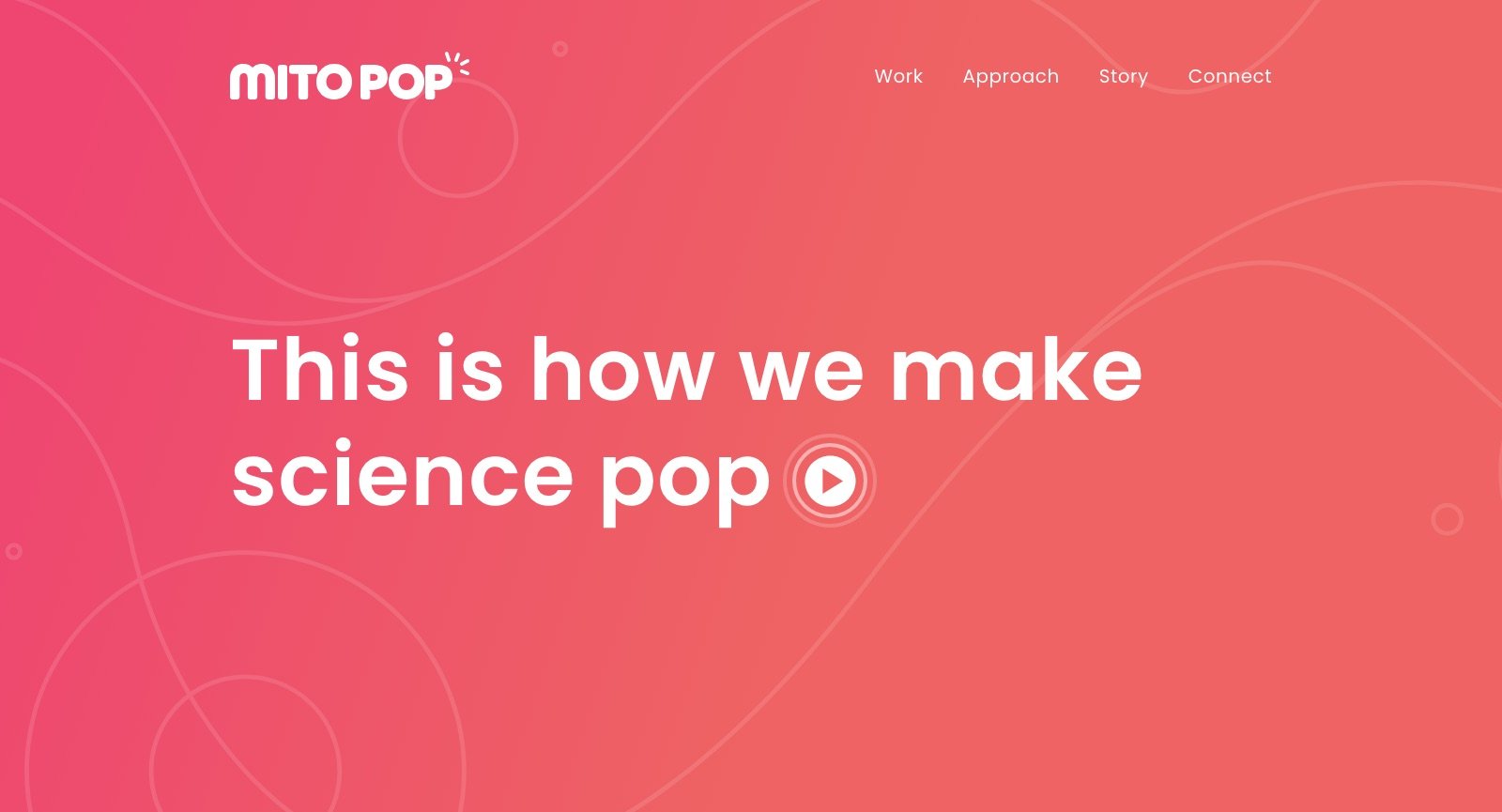
Their line is "This is how we make science pop." The brief had two halves: build the agency's own site, and then help them build everyone else's faster.
A bespoke WordPress theme - no page builder, no bloat - built around bold type, saturated gradient fields, and motion that carries the "pop" without tipping into noise. The site's job is to prove the agency can make technical material feel alive, so restraint everywhere except where it counts.
The build is a modular block system: hero treatments, case study layouts, video embeds and explainer graphics compose from a fixed component set. Performance mattered more than usual here, because a site full of video and gradient work is exactly the kind that gets slow by accident.

An agency that builds sites for other people accumulates a specific kind of drag. Every client project repeats the same opening two weeks: stand up the environment, scaffold the theme, wire the same dozen content types, rebuild the same navigation and form and card patterns, re-solve accessibility and responsive behaviour that was already solved on the last three projects.
None of that is the work clients are paying for. It is the tax you pay before the work starts - and for a small team it's the difference between taking on four projects a quarter and taking on six.
The repetitive part of client web development isn't repetitive because it's simple. It's repetitive because it's well-specified - and well-specified work with a clear definition of done is the kind agents handle well.
I set up agent-driven workflows that take the specified half of a client build off the team's plate, working against a shared component library rather than generating markup from scratch.
The constraint that makes this safe is the same one I use everywhere else: the agent operates against a closed set of known-good components. It has latitude in how it composes them and none at all in what it can emit. When something new is needed, that's a human building a new component - deliberately, once, into the library.
The opening stretch of a client project compressed from weeks of setup into a scaffold and a review, which moves the expensive human hours to where they earn their keep: the strategy, the visual design, and the 3D and explainer work that is why clients hire MitoPop.
The side effect was consistency. Because every build now composes from the same library, accessibility and performance stopped being something every project had to earn on its own. Fix it once in the library and every build inherits it.